
Bashō and the Crinkle in Time
• From the Private Recollections of Duffy Whitmore •
* Trevor’s Kodachrome Revelation
One seldom expects to encounter a crisis of metaphysics between the fish course and the port, but such is the price of dining at The Meringue.
Lord Thornton—“Ruffles” to his friends, “Bwana” to his man Kamau—had invited us to his estate in the Wanjohi Valley for what he termed a “modest little supper.” As usual, the place was teeming with white-coated staff, all trained in that particular British style of quiet, unobtrusive omnipresence. I counted three separate footmen attending solely to the cheeses.
After dessert (a floating island of meringue served in a shallow lake of passionfruit cream, which Ruffles claimed was an old Thornton family recipe—I have my doubts), we retired to the library for a presentation from Trevor Finch-Bligh.
Now, Trevor had recently taken possession of a new Leica and a curious delusion: that it was capable of capturing moments not only from the present but—by some lens of spiritual eccentricity—the past. He called it his “Magic Leica,” and while we all humored him, the idea had grown wearisome after he claimed to have photographed Vasco da Gama on a Lisbon quayside and what may or may not have been a druid at Stonehenge.
This evening’s lecture promised to be no different.
Kamau had already arranged the projector—a sleek little German model—and one of those portable Silver Screens, recently shipped from Hollywood. Ruffles had purchased it after seeing The Thief of Bagdad three times in Nairobi and declaring that “Cinema is the new diplomacy.” Kamau had not commented.
We assembled in armchairs, the room thick with cigar smoke and clinking glasses. Ruffles, looking resplendent in a cream smoking jacket and patent slippers, took a seat beside me. Rory Thornton, Ruffles’ nephew and a recent convert to photography (his Leica hanging round his neck like a talisman), fidgeted with excitement.
Trevor cleared his throat in that theatrical way of his. “Gentlemen,” he began, as the first slides flickered to life, “what you are about to see may very well alter the course of cultural history.”
“God, not again,” I muttered.
The screen flashed images of Kyoto: temples shrouded in mist, cherry blossoms in bloom, a disturbingly erotic still life involving an octopus, and finally—The Shot.
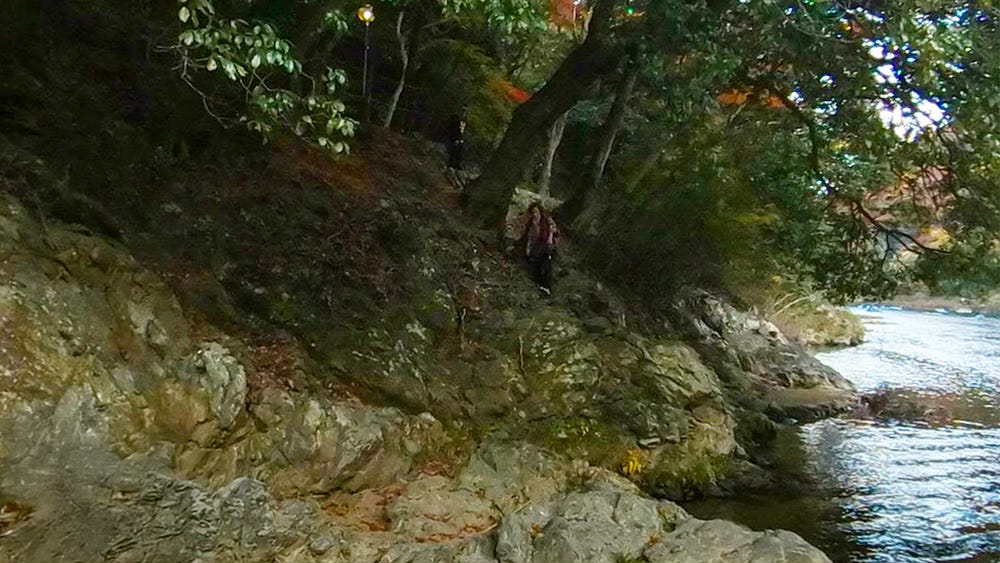
A man, hunched and ragged, was descending a slope of moss-covered boulders toward a misty river. His robes were tattered but graceful; he carried a small bundle wrapped in indigo cloth. His head was shaved, save for a wispy topknot. He looked ancient, serene, mildly amused by something only he could see.
“Gentlemen,” Trevor whispered, “I present… Bashō.”
There was a brief silence, the kind that follows a dropped wineglass at a formal dinner. Ruffles leaned forward, eyes narrowed.
“Is this a reenactment?” he asked.
“No. I was alone.”
“A time slip?”
Trevor nodded gravely.
Rory gasped. “Trevor… this is extraordinary. Medieval Japan, revealed! How do you do it?”
“He doesn’t,” I said.
Ruffles stood, hands behind his back in that faux-military stance he adopts when funding an expedition. “We must go there. We must investigate.”
Trevor beamed. “I thought you’d say that.”
“I’ll fund the trip,” Ruffles declared. “Kamau will make the arrangements.”
Kamau, ever the sphinx, inclined his head. “Yes, Bwana.”
Later, as the others shuffled out toward the billiards room, Kamau lingered beside me. I was pouring a nightcap and lighting a cheroot.
“He’s serious, you know,” I said, nodding toward Ruffles’ retreating figure.
“Yes,” Kamau said softly. “Bwana is learning Japanese. He feels ready to speak to someone in Japan.”
I blinked. “You mean…?”
Kamau offered no answer, only a small, inscrutable smile.
* Arashiyama Arrival
There are few sensations more profoundly dispiriting than arriving in a foreign country after thirty-six hours aboard Imperial Airways. The seats were allegedly designed by a former jockey with a cruel streak, and the in-flight fare bore a striking resemblance to wartime rations, but it was all forgiven when the great green curve of Japan emerged through the haze.
Trevor, Rory, and I stumbled from the plane like spiritual pilgrims, blinking through the diesel mist, while Ruffles disembarked with the calm of a diplomat returning to a colony he’d once governed. Kamau followed silently behind, carrying a single black bag with everything he owned or required.
We reached Arashiyama at dusk, the hills soft with mist and the bamboo groves murmuring like a congregation of polite ghosts. Ruffles had rented a traditional house just beyond the grove. It had paper walls, a koi pond in the courtyard, and the constant, faint gossip of cuckoos from the woods.
“I say,” Rory murmured, peering at the tatami floor. “Is this real bamboo?”
Trevor, who had declared himself an expert on “all things Japanese” after three days with a phrasebook, replied, “Of course it’s real. Everything in Japan is real.”
To which I responded, “Except time, apparently.”
That evening, Kamau arranged dinner at a local restaurant said to serve the finest nabe in Kyoto. It was a low, wood-panelled place, lit like a jewel box.
As we stepped into the lobby, a young woman appeared and bowed so gracefully it was as if she’d choreographed it in a dream. She wore a midnight-blue kimono embroidered with pale cranes, her hair pinned with what appeared to be a single silver chopstick.
“Gentlemen,” whispered Rory, breathless, “she’s a goddess.”
Ruffles stepped forward with a sudden gravity, as if approaching a vision on a mountaintop. He took her hands, bowed low, and said something in Japanese.
She smiled. Her eyes held his in a moment that felt entirely outside of time.
It was then I heard myself whisper aloud, to no one in particular, “Coup de foudre.”
The two Door Supervisors, as we refer to them in London, moved towards us from the rear. They wore dark robes and sandals, with topknots that looked more than decorative. Each carried what I can only describe as a proper samurai sword, slung across the back with theatrical menace.
Trevor leaned in. “Ronin,” he said, eyes wide. “Leftovers from the Edo Period.”
The two Ronin / Door Supervisors, advanced on Ruffles—slow, measured, like crocodiles across a marble floor—but the waitress raised one delicate hand and said something soft and commanding. They halted. Then, in perfect unison, they bowed and stepped back.
Kamau, who had remained near the entrance, tilted his head ever so slightly. Watching. Weighing. Ready.
Dinner was taken seated on floor pillows around a bubbling pot of broth. Ruffles was unusually quiet, speaking only to ask, “What’s that?” or to repeat, “Say again?”
The waitress—her name, we learned, was Marina—served each course with the grace of a tea ceremony. Each time she returned to the table, she knelt before us.
The light from the paper lanterns softened the curve of her cheekbones and caught in the embroidery of her sleeves. There was a delightful tension between her and Ruffles—visible to everyone and acknowledged by none. Gentlemen, after all, are experts at looking the other way.
Later that night, as we strolled back beneath the swaying bamboo, Ruffles walked in silence. I caught Kamau glancing toward him, studying his stride with the eye of a doctor or perhaps a tailor. When we reached the house, Ruffles lingered on the bridge above the koi pond, staring at his reflection in the dark water.
“I think,” he said at last, “I may need to see more temples.”
Trevor, naturally, took this to mean the next day’s search for Bashō was on. Rory was already loading a new roll of Kodachrome into his Leica.
As for me—I suspected temples had very little to do with it.
* Trevor and the Time Slip
The following morning dawned cool and river-scented. Mist clung to the surface of the Arashiyama like silk on wet skin, and somewhere a bell was being rung in the temple district, deep and low, like a memory stirring in its sleep.
Trevor was already up and marching about the garden with a notebook, muttering phrases in his pidgin Japanese.
Rory Maher, resplendent in dinner jacket and polished patent shoes (he refused to dress down even for time travel), had his Leica swinging from his neck like a holy relic.
“I’ve reviewed the topography of the photograph,” Trevor declared, waving a map that appeared to be printed on waxed rice paper. “The boulders are just west of the footbridge. If we time it right, we’ll catch Bashō in the act of existing.”
“You talk about him like he’s a trout,” I said.
Kamau served us tea on the porch. Ruffles was nowhere to be seen.
“He’s staying behind,” Kamau explained, “to study vocabulary.”
Rory nodded solemnly. “He’s with Marina, isn’t he?”
Kamau did not respond. He simply poured the tea.
We set off along the river, three explorers in search of a seventeenth-century poet.
The town was beginning to stir: vendors slicing melons with small swords, monks sweeping temple steps, schoolchildren in pressed uniforms laughing into the wind.
“I’ve always suspected time isn’t strictly linear,” Trevor mused, as we descended a muddy slope. “More of a crumpled handkerchief. And we’re about to poke our noses into a fold.”
At the base of a tumble of mossy boulders, just as described, stood the figure.
A man—lean, elderly, with the air of someone who’d long ago ceased being surprised by anything—stood feeding ducks. His robe was threadbare but clean. His feet were bare. His topknot trembled in the breeze like a weather vane.
“Bashō,” Trevor whispered.
“Not necessarily,” I said. “Could be a local fellow with an unfortunate hairdresser.”
“I’ll flank him from the left,” Rory whispered, already crouching into what I believe he called a ‘pincer movement.’ “Military tactic—Napoleon used it.”
“He also lost to Wellington,” I muttered.
Trevor moved with comic delicacy, camera raised. I stayed back on the slope, somewhere between skeptical and enchanted.
The man turned to face us as we approached. He smiled. “You are looking for someone?” he asked, in excellent English.
Trevor nearly fainted. “Are you… Bashō?”
The man laughed. “No, no. My name is Haruki. I think Bashō is… how do you say… very old now?”
“But you look very old,” Rory blurted out. It was not taken as an insult.
Haruki (if that was his name) invited us up to his nearby cottage for tea. It was a weathered place, with sliding paper doors and a view of the hills that would make Wordsworth give up entirely. Inside, tacked to the wall above a writing desk, was a woodblock print of Bashō. The resemblance was uncanny. Too uncanny.
“We’ve found him,” Trevor said, awestruck. “We’ve only gone and done it.”
I examined the room. On a low credenza lay a stack of paper—calligraphy, written with a brush and pale ink.
“These look… unfinished,” I said, holding up a few pages. “They’re not copies, either. These are fresh.”
Rory was now visibly panicking. “I’ve read about this. In Chronicles of Other Realms, Vol. II. If we stay too long, we could be trapped in a Crinkle.”
“A Crinkle?” I asked.
“A Crinkle in Time,” Rory explained, frantically checking his watch. “Forty-five minutes max. After that—poof. We’re stuck here. I’d estimate this is… 1640? Give or take.”
I checked my pocket watch. “We’ve been here thirty-five.”
“Time to go,” Rory said, striding toward the door. “Say bye-bye. We’ve got the shot, as they say at Life Magazine.”
Trevor hesitated, bowing low to Haruki/Bashō and whispering, “Thank you. Your work has meant more than you’ll ever know.”
The man only smiled.
As we hurried down the path, back toward our rented villa, I looked over my shoulder. The poet was feeding a clowder of cats that had gathered in front of his cottage.
* A Quiet Intervention and Poems and Prawns
Back at the villa, Ruffles stood before the mirror in the main hall, reciting syllables into the fragrant air.
“Sumimasen… Marina-san… o-ai dekite… ureshii desu…”
His tone was reverent, like a schoolboy preparing for confession, and Kamau, standing just behind him, corrected the intonation with a subtle cough.
“You are improving, Bwana,” he said, gently adjusting Ruffles’ collar. “But perhaps do not attempt the conditional tense just yet.”
Ruffles nodded, adjusting his cravat. “Kamau, I intend to be fluent. Not merely conversational—fluent.”
“Yes, Bwana,” Kamau replied, handing him a small wrapped gift. “The hand-embroidered handkerchief. Cranes and pines. As requested.”
Marina had offered to serve as his personal guide for the day—an invitation Ruffles received with the solemnity of a diplomatic overture. As they departed together through the garden gate, she in a pale pink kimono and he in his Panama and cream linen, it struck me that whatever language they spoke, it had little to do with grammar.
While you’re touring the temples with your lovely guide, Miss Marina, I will, with your permission Bwana, take this opportunity to do a bit of shopping.”
Dinner that evening was a triumph.
Kamau had outdone himself, presenting a fusion meal that could have earned him a knighthood, had we still been in the habit of awarding those for culinary diplomacy. It began with sesame prawns in a miso reduction, followed by a slow-cooked oxtail stew with yuzu and fenugreek, and ended with a silken panna cotta of such precision that Rory claimed to have had a religious experience.
“I mean, honestly,” Rory said, licking a dollop from his spoon, “how does he do it?”
Kamau, silent as ever, bowed slightly and vanished toward the kitchen.
We dined on the rear terrace, overlooking the koi pond Ruffles had already begun sketching in his notebook for replication at The Meringue. The air smelled of pine and soy sauce, and the garden glowed with the delicate shimmer of stone lanterns nestled among the foliage.
Rory and Trevor were beside themselves with excitement.
“I calculated that we’ve probably taken at least twenty usable shots,” Trevor announced, sipping a plum wine that may or may not have been medicinal. “Some of them might even be cover material.”
“For Life?” I asked.
“For National Geographic,” he replied, a little too quickly. “Possibly Punch.”
Rory, still clutching his Leica like a sacred relic, nodded. “The calligraphy—Duffy, show them again.”
I held up the sheets we’d collected from Haruki’s cottage. Elegant, brush-drawn kanji danced across the paper like dragonflies. I’d taken the liberty of pressing them between pages of Trevor’s field guide to Shinto architecture, which he hadn’t yet noticed.
“These,” I said, with the solemnity of a man fully committing to a lie he half-believes, “are obviously unfinished poems. Possibly from Bashō’s own hand. We were probably standing in what was once his house.”
Trevor leaned back in his chair, arms folded across his chest like a professor awaiting applause. “We did it. Proof of a temporal anomaly. And a cultural coup.”
“Don’t say coup,” Rory muttered. “It makes it sound treasonous.”
Ruffles had said very little throughout the meal, save for his usual observations about sauce texture and how Japanese tea should never be steeped “angrily.” But at last, he cleared his throat and raised his glass.
“Gentlemen,” he said, “I have good news.”
We turned to him at once, half-expecting an announcement about a medal or a marriage.
“This afternoon,” he continued, “I received a telegram. From Marina.”
He let the name hang in the air like a final course.
“She says she would like to visit. In Kenya.”
“Marina?” Trevor asked, blinking. “Our Marina?”
“There is only one,” Ruffles said, smiling faintly. “I replied at once. I said she must stay at The Meringue. I received her reply an hour later.”
He removed a slip of paper from his inner pocket and read aloud:
“DARLING THAT WOULD BE WONDERFUL”
Rory raised his glass. “To Marina!”
“To Bashō!” cried Trevor.
“To Kamau,” I said. But he was nowhere to be seen.
After dinner, we lingered on the terrace, the ice clinking in our glasses, the koi drifting just below the surface like polite secrets. The air buzzed with cicadas and half-sober speculation.
We imagined presenting our discovery to the Royal Geographical Society. We fantasized about a private viewing at the British Museum. We toyed with the idea of a serialized write-up in The Illustrated London News, possibly with an accompanying LP of ambient flute music recorded on-site.
No one mentioned the possibility that it was all a mirage. Or worse: a carefully orchestrated performance by unseen hands.
And Kamau—our cook, our guide, our quiet watcher—stood in the doorway for a moment before retiring, silhouetted by the kitchen light, his expression unreadable.
None of us noticed him slip away again, just before midnight.
* The Club and the Confession
Hong Kong, on the return journey to Nairobi, felt garish and electric after the hush of Japan. We arrived during the monsoon season and were promptly caught in a downpour so theatrical it might have been produced by Cecil B. DeMille.
Our first stop was, of course, the Foreign Correspondents’ Club—a colonial holdover perched above the sweating rooftops of Central, where they still served ice in silver buckets and the waiters wore white gloves with the weary dignity of men once employed by dukes.
Ruffles retained a membership there, a legacy of some forgotten diplomatic mission involving silk tariffs and a Portuguese consul’s niece.
He led us through the bar like an admiral returning to port.
We took the corner table—his table—and ordered whiskey sodas and something involving crab and toast.
Trevor and Rory were jubilant.
“I’ve already had a telegram from the Times of East Africa,” Trevor declared. “They want a quote for a front-page piece. Possibly a feature.”
“No comment,” said Ruffles, crisply. “That is our position.”
“Even for the Geographical Journal?” Rory asked.
“Especially for them,” Ruffles replied. “We shall release our findings when we are ready. Until then: no comment.”
Trevor nodded solemnly, clearly imagining how well this would play in print. Rory sipped his drink and whispered, “What if we’re summoned before a council? You know—Oxford dons in gowns, that sort of thing.”
“I’d wear my safari whites,” Ruffles said, without irony.
I said very little. I was still holding something of Kamau’s inside me—his silence, his skill, his invisible choreography of our entire little myth.
That night, I wrote two versions of my report for the Royal Society—one containing the whole truth, and one containing none of it. I sealed both in envelopes and left them in my suitcase.
I didn’t know, then, which one I would send.
• • •
Several weeks later, back in Nairobi, I spotted Ruffles’ Rolls parked outside the Indian grocery where one could acquire cardamom in bulk.
I stepped inside and there was Kamau, standing at the counter, comparing packets of jasmine rice.
“Mr. Whitmore,” he said, without surprise.
“Kamau,” I replied. “Shopping for Bwana?”
He nodded, then paused.
“There is something I must tell you,” he said quietly. “You must promise not to tell Bwana. It would embarrass him.”
I raised an eyebrow. “What on earth could possibly embarrass Ruffles?”
Kamau hesitated, then led me outside and told me the story—his story.
How he had gone to Marina’s house. How he had warned her. How he had quietly slipped up to Haruki’s cottage and tacked the Bashō woodblock to the wall. How he had hired a calligrapher, placed the poems, arranged the scene like a stage set.
And how, after dinner that evening, he had left through the kitchen’s side door and met the Ronin in the alley. How they had dealt with the men who had roughed up Ruffles and warned him to leave Japan. How those men would not be returning.
He told it all in the same even tone he used when describing stew or dusting shelves.
When he finished, I said nothing for a long moment.
“Why?” I finally asked.
Kamau looked at me, his expression unreadable. “Because Bwana believed,” he said. “And Trevor. And Rory. And perhaps you, a little. I wanted them to have what they came for.”
“And what did you get?”
He looked down the road where the Rolls waited in the sun. “I got what I always get. Quiet.”
I nodded. “Thank you, Kamau. I won’t tell them.”
He bowed slightly. “It would ruin the story.”
I watched him return to the shop, a small bag of rice in hand. A man vanishing into his role again.
And I realized he was right. The truth would ruin the story. Even if it made it more remarkable.
* No Comment
I found myself wandering the grounds of The Meringue, admiring the half-finished koi pond being excavated in the shape of Honshu. The gardener had mistaken the outline for a silhouette of a rhinoceros and was constructing as an island near Kyoto, that had never existed. Ruffles, naturally, was supervising in a panama hat and linen suit, sketchbook in hand, oblivious to the cartographical liberties being taken.
Kamau stood a few steps behind, silently redirecting shovels and correcting geography in the language of nods.
The Bashō Expedition had become legend already—at least in our circle. Trevor had given a lecture at the Nairobi Club titled “Temporal Slippages and the Poetics of Evidence”, which featured one of the Haruki photos projected dramatically onto a linen bedsheet. Rory, bless him, had started work on a novel—The Bamboo Hour—which I gather begins with a character based on himself discovering time travel in a packet of Fuji apples.
And Ruffles? Well, he said very little on the subject. When asked, he’d smile faintly and say, “No comment,” in a way that suggested a royal scandal or a discreet affair with a duchess. Which brings me to…
Of course, there were things none of us said.
It was never officially acknowledged, for instance, that Ruffles had not returned to our villa the night before the Ronin… incident. We all knew where he was—Marina’s small wooden house with its lacquered bowls and bamboo blinds, and her warm, inviting futon. He left at dawn, walking alone through the still-sleeping alleys of Arashiyama.
It was in one of those alleys—narrow, stone-lined, echoing with the faint sounds of morning rice being washed—that two men intercepted him. Plainclothes. Government, or a version of it.
They cornered him, said nothing at first, and then spoke in unnervingly crisp English.
“For your continued good health,” one said, “we advise you leave Japan. You have twenty-four hours. We’ll be watching.”
No one ever learned who they were.
Ruffles returned to the house a little after six. His collar was slightly torn. One cuff had blood—not much, just a dignified smear. Kamau received him as if nothing were out of place.
“Bwana,” he said calmly, taking his coat, “I’ve prepared tea and toast. You’ll find it on the terrace, overlooking the pond.”
Nothing more was said. And within the hour, the Ronin had been… engaged.
Kamau offered me a small smile and said, “Marina is due to arrive in one week. Her telegram arrived this morning.”
I nodded, unsure how to respond.
“She will stay in the guest pavilion,” Kamau added. “It overlooks the koi pond.”
There was a pause.
“She doesn’t know,” I said finally. “About the mugging. The men. The Ronin.”
“No,” Kamau said. “It would embarrass him.”
And so, we let the story stand.
Rory and Trevor kept their photographs. I submitted the second report—the more… tasteful one. Ruffles’ koi pond was completed, with Marina arriving just in time for the inaugural pouring of tea beside the stone lanterns. She wore a pale blue dress and carried a parasol with cranes stitched into the silk.
I never mentioned the futon. Nor did she.
As for the calligraphy? It remains in a drawer in Ruffles’ study, beneath a humidor and an unfinished monograph on Japanese tea houses. Sometimes, when he’s had a sherry too many, he’ll pull it out and examine the brushstrokes, murmuring about “crinkled pockets of time.”
But when the press comes calling—and they do, from time to time—Ruffles smiles, sips his tea, and says, “No comment.” Which is precisely the comment a gentleman makes when the truth is far too good to ruin.
— Duffy Whitmore


