
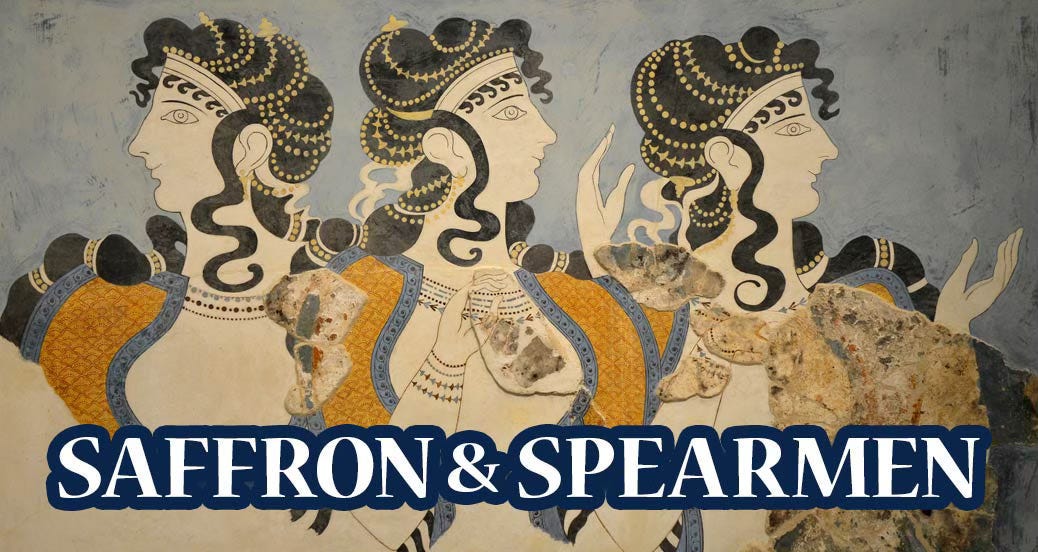
Saffron and Spearmen
• Santorini, 1937 (or Thereabouts) •
The hotel was perched somewhere between metaphysics and geology—half-eagle’s nest, half ruin—overlooking the bleached puzzle of Fira Harbour. A German named Hans ran it, or possibly his wife, or possibly a system of levers; one could never be sure. The bath had a curious habit of draining into the kitchen, which we discovered only after Trevor attempted a hot soak and Hans reappeared three minutes later with a face like Euripides’ Medea.
We were convalescing, if such a word could be used to describe a week of gin and lemon tonics on the veranda. The cause of our condition had been a disheartening expedition across the western coast of Asia Minor, tripping over Hellenistic amphitheatres like potholes, Trevor photographing dusty stones with all the excitement of a child who’s found pornography in the attic. He called it “ruin fatigue.” I called it “academic indigestion.”
Trevor Finch-Bligh—photographer, historian, and part-time optimist—burst into this already agreeable tedium by proposing we hire a small sailboat to pursue a field of saffron allegedly visible from the sea, “just past Skaros Rock.” He had discovered its mention in his Baedeker’s guidebook, which he treated with the same reverence monks once reserved for illuminated gospels.
“You’ll love it,” he insisted, thumbing the page as though divine truth might be smudged into clarity. “Kodachrome! Imagine! Colour transparency! Golden crocus in Aureolin sunlight—it’s practically a Minoan fresco already!”
So, we descended like Homeric shades into the harbour. Trevor found a boat with a sail dyed the colour of oxidised marzipan. He declared it ‘ideal.’ It had neither name nor an anchor, but came with two oars and a Greek boy who refused to stop smoking. The boy declined to join us, muttering something about ghosts and disappeared shepherds. Trevor waved him off with a banknote and a speech about ‘the spirit of Thalassa.’
He took the tiller with the swagger of a Venetian doge, and I rowed us clear of the mackerel flotilla dozing in the harbour. Around Skaros Rock, the Aegean became theatrical. The cliffs rose like a broken colonnade, and I half-expected Eurydice to appear and demand the oars.
We found the field easily enough, a strange golden glow, sloping towards the sea. No path, no road, no industrious donkeys or excursionists with binoculars. The silence had a certain stagey quality. As we beached the craft, Trevor photographed the boat, the saffron, me, the sea, and a particularly photogenic boulder. The camera clicked with the devotion of a man placing bets on immortality.
Then we saw them.
Two women, emerging from the crocus as if conjured, not walked. They were bare-breasted, barefoot, and bewitched—or bewitching, depending on one’s degree of classical education. Their garments, if such a term is permissible, were rather more ceremonial than practical. I said as much.
“A tableaux vivant, surely,” I muttered, recalling that infamous afternoon in Versailles when two schoolmistresses mistook a pageant for a portal through time. “Minoan cosplay, perhaps?”
“Oi! Hello!” I shouted.
Trevor waved like a mariner greeting mermaids. “We come in peace!” he called. The words hung in the air like bad diplomatic policy.
He snapped a photo, then whispered, “I must get closer. Their eyes, Duffy, they are prehistoric!”
That’s when they ran. Fast. Up the hill, like hares escaping history itself. Their garments billowed, their movements stylized and urgent. Trevor swore and stumbled after them. I stayed where I was. It seemed safer.
Moments later, two figures appeared on the ridge—men this time, shirtless and glinting with menace. They wore loincloths, leather sandals, and, most importantly, carried spears. Very convincing spears.
“Oh dear,” I said.
“They’re going to kill us!” Trevor screamed, flinging his camera away in an act of panic.
We ran. I have no shame in admitting it. We stumbled down to the beach, half-tumbling, half-praying. Into the boat, into the surf, into salvation. One spear missed. Another embedded itself in the helmsman’s seat, which I had previously used to balance a thermos of gin.
By the grace of physics and raw cowardice, we made it back around Skaros Rock, sails snapping in the wind, our dignity dragging behind us like seaweed.
That evening, the Aphrodite Lounge offered whiskey and explanations. Trevor attempted both.
“We stumbled into a ritual! A trap! The women were bait!” he proclaimed to a barman polishing the same glass for ten minutes.
“Most likely, sir, you interrupted a documentary,” the man replied. “The museum often films such things. Minoan re-enactments. Very authentic.”
Dinner was served on the terrace with just enough pomp to make one suspicious of the chicken. The sun had set behind Thirasia like a Roman curtain drop, and the harbour below twinkled.
Trevor, hunched over his moussaka like a defeated archaeologist, and had not spoken for several minutes.
“I’ve decided,” he said at last. “First light. I’m going back for the camera.”
“I assumed as much,” I said, buttering a roll with the delicacy of a surgeon. “And I’ve arranged my morning accordingly. I’ll brunch here—Eggs Benedict, the hotel’s absurdly good Ethiopian coffee—and keep a pair of binoculars trained on Skaros Rock. If you make it back alive, I shall raise a toast. If not, I’ll raise two.”
Trevor groaned into his wine. “You think I’m mad.”
“Not at all,” I replied.
A waiter appeared with a dessert that looked like a Byzantine reliquary. Trevor pushed it aside.
“You know what the barman said,” he continued. “That it was just a film shoot. Some museum thing. Hired actors. That explains the spears. The loincloths. The… breasts.”
I nodded. “Entirely plausible. Very modern. Very Greek.”
He looked at me sideways. “You don’t believe it.”
I considered the night air, the stillness of the cliffs, the absurdity of every moment since we’d left the hotel that morning.
“No,” I said finally. “I don’t. But I don’t believe the other explanation either.”
“What other explanation?”
I leaned back and swirled the last of my wine. “That what we saw was not an historical re-enactment… but history itself. Not a performance, but a recurrence.”
Trevor frowned.
“At Versailles,” I went on, “those poor schoolmistresses wandered into a tableau vivant and mistook it for history. What if we’ve done the opposite? What if we stumbled—briefly—into the actual past and, like sensible modern men, assumed it was just a bit of dress-up?”
He stared at me, open-mouthed.
“Think about it,” I continued. “Everything had that odd sheen of unreality. No tourists, no road, no plastic chairs or modern rubbish. Even the air smelled ancient—like hot thyme and primitive rituals. It was as if we’d turned the page back by mistake and found ourselves in a chapter no one reads anymore.”
“You’re serious?”
“Only ever by accident.”
Trevor said nothing more that evening. He went to bed early, muttering about focal lengths and the price of fear. I stayed behind, watching the harbour lights flicker like distant thoughts, wondering—as one does after too much wine and just enough myth—whether time is really so well-behaved after all.
—Duffy Whitmore


