
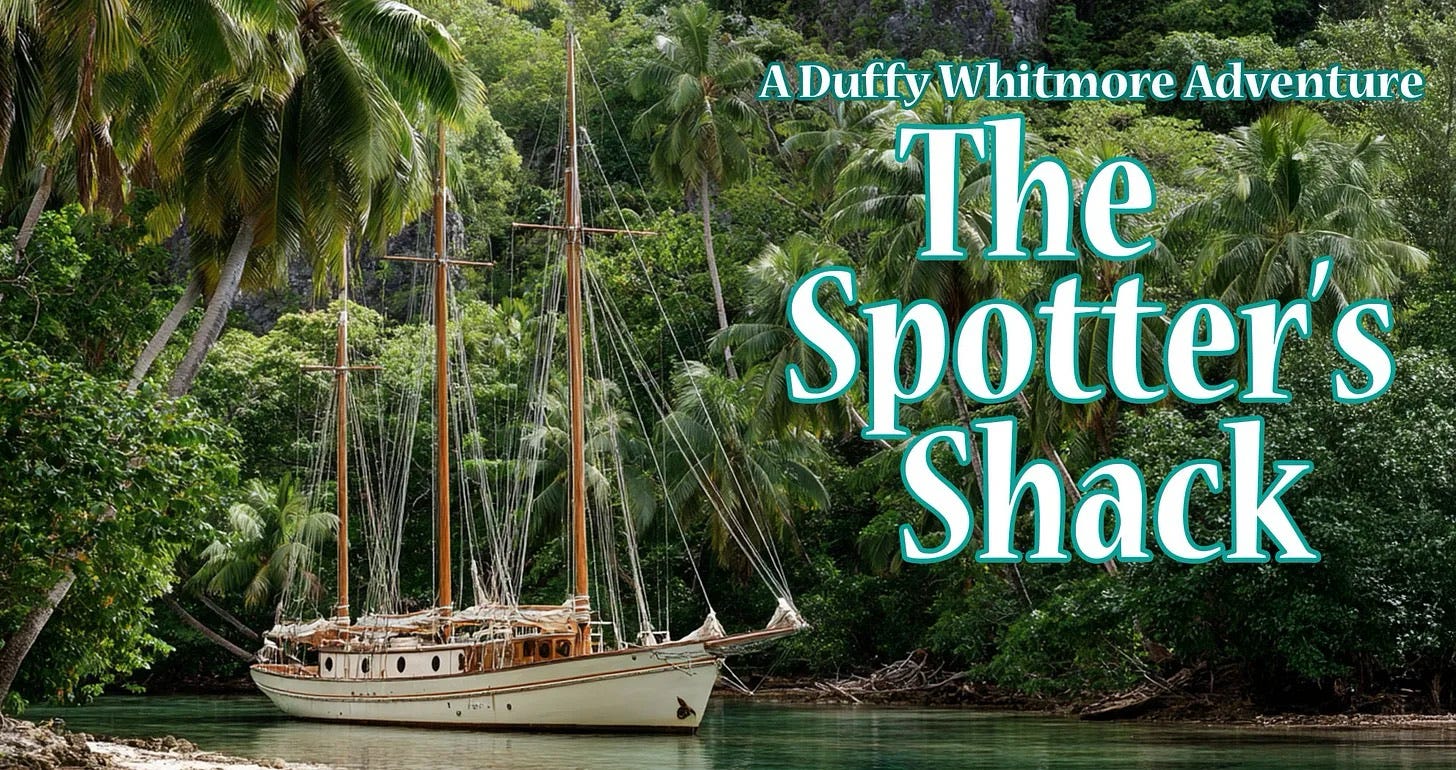
The Spotter’s Shack
• A Duffy Whitmore Adventure •
The Spotter’s Shack
By Duffy Whitmore
Chapter I – Rosehip in the Moonlight
We made landfall at dusk, though landfall is rather too grand a term for our soft-nosed approach to a coral-wrapped crescent of tropical indolence. The Rosehip—Lord Thornton’s teak yacht, polished to a sullen gleam and as stubbornly British as a buttered crumpet—glided into the lee side of Eglantine Isle (so christened by Ruffles after a half-remembered poem and a wholly-remembered bottle of rosé) as if it had done so before, though charts marked the place with only a rude swirl and the note: Uninhabited. Possibly volcanic.
“She’s no volcano,” Ruffles declared, setting down his binoculars and flexing the sort of forearms that once hoisted gunsights in East Africa and now hoisted iced gin in East Mombasa. “She’s a good girl. A very good girl.”
Rory had taken to wearing only linen shorts, a pith helmet, and a necklace of dog tags of unknown origin. He was applying coconut oil to his knees with religious devotion.
“I feel a change coming,” he muttered.
“You’ve got heatstroke,” said Trevor, who was sunburned, shirtless, and thumbing through The Golden Bough as if it might contain instructions on how to converse with half-naked goddesses in Polynesian dialects.
Kamau stood barefoot at the prow, hands behind his back, perfectly balanced despite the swell. His fez—by now quite threadbare—clung to his head as if by spell. He alone looked ready to found a republic or win a naval commendation. I was just trying not to drop the silver tea service.
“Steady on,” I said, as we passed a reef that looked like it might resent intrusion.
Rosehip moored without fuss. Kamau supervised the anchor drop. I supervised the sherry.
The shore was low and lush—pandanus, breadfruit, and towering coconut palms, each bearing the weight of some indeterminate history. The boat hut on Eglantine’s Vahine Beach had been assembled in advance (a favour called in, a fee quietly paid), and now stood like a Croquet Pavilion that had absconded from Kent in a drunken haze and washed up here, complete with a flagpole and a half-hearted windsock.
There were five huts arranged in a crescent and a lavatory that bore the discreet stencilling: “Constructed by Her Majesty’s Engineers, 1928.” There was bamboo piping for the water, a whisky store behind a false bookcase labelled Naval Signalling: Volume III, and a hammock strung between two palms that Rory insisted had spoken to him. The man was in a delicate state.
We dined aboard the Rosehip that first night, more from habit than necessity. Ruffles insisted we not “go native” too quickly. I believe his exact phrase was: “Let the jungle peer in, if it must—but we shan’t be flinging open the shutters just yet.”
Kamau brought out the maps. Trevor brought out the rum. Rory brought out his ukelele and attempted a rendition of I’ll Be Seeing You, which somehow ended in a lament for an American stewardess he’d met once in Darwin.
I went ashore after supper, alone, as the moon was rising over the island and the palms whispered things they clearly hadn’t told the Admiralty. I found the lavatory rather better than expected, the beds adequate, and the view—of the sister island across the narrow channel—so lovely I nearly forgave the Empire for all its sins.
She rose out of the sea like a sleeping figure in a carved canoe: the larger island, roughly a mile off, and known to us only as Vahine Island, based on some half-buried reference in a captain’s log and Rory’s loose translation of a local legend. We believed it uninhabited—indeed, perhaps never inhabited at all. That, as we would later learn, was an error of some consequence.
I returned to the Rosehip to find Ruffles plotting out croquet lanes on a topographical map and Kamau setting out quinine pills beside our wineglasses.
“To health, and to temporary exile,” said Lord Thornton, raising his glass.
“To forgotten islands and remembered names,” I added, though I hadn’t any names in mind just then.
We drank, and I remember thinking that if anything did happen—if war, or ghosts, or Polynesian sorceresses decided to intervene—it would be, at the very least, amusing.
And so, by moonlight, we stepped ashore. We had no inkling of Captain Paterson, nor of camouflage nets, radios, or the “Able-Baker” codebooks that would soon determine whether we were spotters, fools, or mere shadows in the jungle.
But that was all to come.
Chapter II – Polynesian Proximities
It was the second morning, and we had not yet quarrelled—a suspicious start, in my experience. Even Rory, who had slept outdoors in what he called a “hammock bivouac” (complete with mosquito netting and a copy of Leaves of Grass tucked under his arm), appeared oddly serene.
Breakfast was taken beneath a breadfruit tree: eggs (tinned), marmalade (English), and a leathery local fruit we referred to as “island plums” until Kamau informed us, quite gently, that they were neither.
Trevor, who had been up early sketching vines and theorising about pre-Christian fire rituals, returned breathless and sun-dappled.
“I’ve found them,” he said.
“Found what?” I asked.
“The Vahines. Possibly pre-contact. Almost certainly matrilineal. They were bathing. At a waterfall. There were flowers in their hair and spears on the ground. One of them looked exactly like a bronze at the British Museum.”
“Are you certain they weren’t coconut gatherers?”
“No,” he said. “They shimmered.”
Ruffles looked up from his folding chair.
“You didn’t speak to them, I hope?”
Trevor was silent a moment. “I bowed.”
Kamau refilled the tea. “I believe the Royal Geographical Society discourages bowing to people you’ve just discovered, sir.”
Trevor produced a torn page from his sketchbook. It featured a semi-nude figure of improbable grace, balancing a basket on one hip and glancing backward over one shoulder in what can only be described as classical Polynesian contrapposto. There were flowers, yes. Also spears.
“She seemed to be leading the others. I think she’s the matriarch. Or the regent. Or a spirit.”
“You’re not drinking the palm wine again, are you?” I asked.
“Only ceremonially.”
We debated the nature of his encounter over elevenses. Ruffles maintained that the women were part of an Australian government experiment in female-led agriculture. Rory was convinced they were nuns. Kamau, as usual, withheld judgement until more evidence arrived, which it invariably did.
That afternoon, while inspecting the camp’s bamboo piping system (which had begun to gurgle ominously), I found Trevor packing a haversack with field notebooks, sketching pencils, and a large tin of biscuits.
“You’re going back,” I said.
“I must,” he replied. “It would be academically irresponsible not to.”
“You’re bringing an alarming amount of talcum powder for an academic.”
“Humidity,” he said. “And etiquette.”
I let him go, with a strict injunction to remain visible and not to attempt any ritual drumming, however “natural” it might feel. Rory, who had been tying seaweed into his hair, offered to accompany him. Trevor declined. “This is something I must get wrong on my own,” he said.
Trevor returned at dusk, barefoot, slightly scratched, and in a state of profound ecstasy.
“They sang,” he whispered, as Kamau administered iodine.
“Did they offer you food?” I asked.
“Only silence.”
“Did they ask you to leave?”
“No. They smiled. It was the smile of someone who already knows how the story ends.”
We retired to the deck of the Rosehip, where Ruffles, undisturbed by metaphysical revelations, was practising semaphore with two cocktail napkins. He waved them with great solemnity in the direction of the larger island.
“I believe that’s Vahine Island,” he said. “Though no one seems entirely sure.”
Rory stared out at it, now a silhouette against the moonrise.
“Vahine,” he said dreamily. “It means woman, doesn’t it?”
“Yes,” said Kamau. “And, occasionally, trouble.”
Chapter III – Howya Goin’, We’re at War
It was midday when the Rosehip’s nautical stillness was disturbed—not by weather, which remained offensively perfect, but by the mechanical growl of two Australian naval cutters rounding the eastern promontory like bulldogs sniffing out a gin rickey.
Rory was in the hammock reading Hawaiian Mythology. Trevor was rinsing a roll of film in a coconut shell. Ruffles was inspecting a compass rose he’d redrawn in the sand using a stick and what I later realised was his toothbrush.
“I say,” he remarked, without looking up, “those are rather official-looking boats.”
I reached for the binoculars. Kamau was already at the shoreline.
“They’re flying the White Ensign,” he said, not unhappily.
Moments later, the boats grounded smartly on the beach and discharged a squad of grinning, sun-hatted Australians in navy khaki. They moved with the casual efficiency of men who had been instructed to treat all things as temporary—including orders, equipment, and war itself. They unloaded crates (marked RATIONS, RADIO EQUIPMENT, ANTI-MOSQUITO) with disconcerting cheer.
A tall man in a battered officer’s cap stepped forward and doffed it with a flourish.
“‘Owya goin’? Captain Paterson. Royal Australian Navy. Sorry to drop in, chaps, but I’m afraid we’re commandeering your island for the war effort.”
Ruffles blinked. “War? What the devil are you on about?”
Paterson smiled apologetically. “Bit of a kerfuffle on. The Japanese are making their way through the Solomons, and Sydney thinks this little patch of paradise might offer useful eyes and ears.”
“You mean to say you’re pressing us into service?”
“I’d rather say enlisting local knowledge. You’re now officially trained observers for the Royal Navy. Spotters, if you prefer.”
“We’ve only just unpacked,” said Trevor.
“You’ll be unpacking new things shortly. Charts. Binoculars. Field radios. The whole shebang.”
“And the Rosehip?” I asked, as the Chaps turned to gaze fondly at her varnished hull.
Paterson pursed his lips. “Couldn’t risk her being spotted from a plane. Rather distinctive. We’re draping her in camo netting and shifting her just inside the reef. She’ll be invisible by nightfall.”
Kamau nodded. “Much better than scuttling her.”
“I was told scuttling was an option,” Paterson admitted. “But seemed a shame. Lovely ship.”
“Indeed she is,” Ruffles growled.
The rest of the afternoon passed in an uncharacteristic flurry. The Australians demonstrated use of the Type 3 field radio. Kamau mastered it instantly. Rory nearly electrocuted himself. Trevor accidentally tuned into a Polynesian soap opera, which he insisted was “a remarkable oral history performance.”
Each of us was assigned a hut—discreetly concealed in the inner forest. The foliage had been artfully rearranged by the Australians, who seemed to possess a natural flair for tropical concealment.
Before the Aussies left, Paterson laid out the final condition.
“You’ll rotate shifts. Two men on Eglantine Isle. Two on the larger island—what was the name?”
“Vahine,” said Rory, dreamily.
Paterson raised an eyebrow. “Means ‘woman’ in Tahitian, doesn’t it?”
Kamau gave a quiet, knowing smile.
“There are women there,” said Trevor, not looking up from his Leica. “They shimmer.”
Paterson paused. “Well. All the more reason to rotate. Let’s not start any frontier marriages.”
The cutters departed with waves and good-natured catcalls. The island, now militarised in spirit if not in posture, fell quiet again.
That night, we dined in the Rosehip’s saloon. The oil lanterns cast their usual honeyed glow. Ruffles polished the Harrison chronometer with a cloth embroidered Hôtel de Crillon, 1929. Kamau served a slightly bruised mango atop a silver dish and offered whisky in glasses that clicked satisfyingly into place when returned to their shelves.
Outside, in the moonlit hush, our new duties waited.
Rory poured another drink and stared at the charts.
“I don’t know the Japanese word for flirtation,” he said, “but I intend to learn it.”
We drank to that. And to the Spotter’s Shack, wherever it might lead us.
Chapter IV – Hut Duty Rotation
The rotation system began the following morning with an imperial sense of order and ended by tea with two missing socks, a mild case of heatstroke, and a spirited debate over whether coconut milk was a suitable substitute for Earl Grey.
Kamau drew up the schedule. It was, naturally, flawless: two men stationed on Eglantine Isle, two on Vahine. Three days on duty, three days off. Spotter shacks had been installed in the islands’ interior highlands—shaded, camouflaged, and unpleasantly fragrant. Each was fitted with a field radio, a collapsible cot, silhouette charts for enemy aircraft and ships, a water drum, and a tin labelled Biscuits, Tactical.
Trevor Finch-Blythe and I drew the first shift on Vahine. Rory and Lord Thornton remained on Eglantine, though Ruffles insisted on referring to it as “Headquarters” and began writing daily memoranda to no one in particular.
Trevor’s Spotter’s Shack—elevated above a small ravine—had the charm of an abandoned henhouse and smelled like something lost in translation. We unpacked our kits, surveyed the charts, and tested the radio.
Trevor cranked the generator, donned the headset, and began his inaugural call to Naval Command, Sydney:
“This is Station Able-Tare-Fox transmitting from Grid Quadrant Niner-Zed-Niner, come in, over.”
A long squawk of static answered.
“Able-Tare-Fox to Base Command. Requesting confirmation of frequency. And—er—are there any enemy vessels in the vicinity? Over.”
More static. Then, faintly:
“Able-Fox-Baker this is Command. Negative on hostile movement. Repeat, negative. Please confirm bearing of reported foxbat over reefline. Over.”
Trevor blinked.
“I didn’t report a foxbat,” he whispered. “What’s a foxbat?”
“You probably mispronounced something,” I said, checking the chart. “Maybe they thought you said ‘Foxtrot Bat’?”
“I said Fox. For Fox. As in the Able-Baker phonetic code.”
“You said Tare-Fox. That’s Tango-Foxtrot in modern terms, which isn’t even alphabetically sequential.”
“This is precisely why I prefer semaphore.”
At twilight, we took shifts at the radio. I kept my reports brief:
“This is Station Able-Easy-How transmitting from elevation four-nine metres. Visibility fair. No enemy vessels or aircraft sighted. Over.”
And then:
“Correction: local seabird has landed on radio aerial. Repeat, not Japanese drone. Just a bird. Over.”
Sydney’s reply was crisp:
“Copy that, Able-Easy-How. Please advise next time before initiating an emergency signal. Bird classified as Non-Hostile.”
Trevor sulked. “They’re mocking us.”
Rory, meanwhile, attempted a supply request using the radio on Eglantine:
“Able-Roger-Roger-Yoke calling Base Command. Require re-supply of tinned peaches and—er—Beef Wellington, if possible. Over.”
A long pause. Then, drolly:
“Negative on Wellington. Sending Bully Beef and Poetry Anthology.”
Life in the shacks fell into a rhythm of semi-competence. We awoke with the sun, recorded vessel sightings (usually dugout canoes), swatted insects with a back issue of The Illustrated London News, and counted the days until it was someone else’s turn to be devoured by mosquitos.
Kamau, of course, became a paragon of spotting excellence. His logs were meticulous. His signal reports were praised by Sydney. He had taken to using the phonetic alphabet with the sort of musical precision one associates with professional cellists.
“Able-King-King to Base Command. Single-engine floatplane spotted, bearing One-Niner-Zed. Request confirmation. Over.”
Back at the Rosehip, Ruffles had taken to donning a naval dressing gown and referring to Kamau as “Commander,” which Kamau bore with the same expression he used for snakes and Anglican hymns.
Trevor’s mood brightened when he spotted the bathing vahines again—this time, from his perch with the Leica. He swore they waved.
“I’m beginning to believe,” he said, “that this island may be timeless.”
“I believe you need to wind your watch,” I replied.
Our first week ended with only one false alarm, three confirmed seabirds, and a misinterpreted reference to a “Zero bearing East” that turned out to be Kamau’s remark about the whisky supply.
Still, the codebooks were smudged with fingerprints, the radios functioned, and the Chaps—despite their various eccentricities—were operational.
Somewhere out there, the war carried on. But in the Spotter’s Shack, beneath the thatch and the camouflage netting, we had found a rhythm of our own.
Chapter V – The Crinkle Expands
Trevor Finch-Blythe—now officially designated “Able-Fox-Zed” by Naval Command—had taken to sketching spirals in the margins of his spotting log.
“These aren’t just doodles,” he insisted, flipping open the waterproof brass case that held his precious rolls of exposed Leica film. “They’re—well—emanations.”
“From what?” I asked.
He pointed vaguely toward the jungle.
“From time.”
The event occurred, or so he claimed, on the third evening of his second shift rotation. He’d gone inland for water and, as was his habit, wandered slightly beyond the prescribed patrol radius.
There, beneath a thicket of hibiscus, he claimed to have witnessed “a distortion of light, not unlike heat-ripple over tarmac, except it formed a helix and moved with uncanny deliberation.” A shaft of sunlight passed through the spiral like a stained-glass lance. And in its midst stood the matriarchal Vahine, whom Trevor had now named Tevarua—the name coming to him, he said, “fully formed, like a baptismal recollection.”
I asked if he’d managed a photograph.
“Only one,” he said. “The shutter jammed afterward. When I wound it back, the reel was hot.”
Back at the Rosehip, we took the incident with our usual diplomatic scepticism, which is to say: Rory applauded, Ruffles grunted, Kamau wrote something in his notebook, and I began preparing a statement for the Royal Geographical Society just in case any of it turned out to be true.
Kamau, for his part, observed a peculiar shift in the environment. “Birdsong patterns are changing,” he noted. “There is also a rhythmic thumping in the canopy at dawn—possibly drumming, possibly coconuts.”
I suggested he consider the possibility of ghostly Polynesian percussionists. He did not smile.
We decided to verify Trevor’s sighting. Kamau and I trekked to the site and found—oddly—a circle of smoothed earth in the middle of the jungle, about nine feet across, no tracks, no prints, just a single white blossom left precisely in the centre.
“I believe you’ve found the set for an avant-garde opera,” I told him.
Kamau crouched low. “Or a ceremony.”
Later that night, back in the shack, I saw something myself. A flicker of motion at the treeline. A pulse of faint blue light.
I reached for the field glasses and saw… nothing. Or rather, I saw what had always been there—palms, moonlight, the heavy hush of a windless sea—but all of it felt staged, arranged. Expected.
I radioed it in.
“Able-Easy-How to Command. No vessels. No aircraft. No unusual movement except a vague premonition of metaphysical drift. Please advise.”
To their credit, Sydney replied.
“Understood. Possibly heatstroke. Drink water. Refrain from abstract metaphysics in future comms.”
Fair enough.
Meanwhile, on Eglantine, Rory was attempting to fulfil his spotting duties while fending off the most charming incursion in the history of colonial field observation.
The Spotter’s Shack had been quiet most of the day—Ruffles had gone off to inspect the camouflaged netting with a brandy and field glasses, and Kamau was presumably hauling Finch-Blythe back from whatever century he’d wandered into. Rory, shirt half-buttoned, was at his post.
The Vahine entered without a sound, as if part of the hut’s woven walls had simply unfastened itself into life. She was barefoot, with a tiare blossom in her hair and a calm, amused expression. Rory, to his credit, did not faint. But he did lean backward rather suddenly, upsetting a folding stool.
“Ah,” he said, regaining balance. “You’ve come to—ah—deliver a message from the, er, council of elders?”
She said nothing. Instead, she drifted toward the wall where a laminated silhouette chart displayed the profiles of Japanese aircraft. She ran her finger slowly along the column.
First: Zeke — the Mitsubishi A6M Zero, that nimble little killer that had chewed through the Pacific like scissors through bunting.
Then: Val — the Aichi D3A dive bomber, remembered best by those who barely lived to describe it.
Finally: Betty — the Mitsubishi G4M, long-range bomber. The one that carried Admiral Yamamoto to his doom.
She paused there. Tilted her head. Said nothing.
At the time, we chalked it up to flirtation. But later, after the records were read and the reports decoded, I wondered if she hadn’t been trying to tell him something.
The radio crackled to life.
Rory scrambled for the headset, only to find the Vahine now inspecting the elevation contour map beneath his notebook.
“Able-Roger-Roger-Yoke, this is Base Command. Please confirm vessel sighting. Repeat, confirm sighting at coordinate Baker-Zed-Niner. Over.”
The Vahine picked up a pencil and drew a small smiley face in the ocean margin.
Rory pressed the transmitter:
“Base Command, sighting unconfirmed. Repeat: vessel possibly a canoe. Or large driftwood. Or spiritual metaphor. Standing by. Over.”
“Copy that, Able-Roger-Roger-Yoke. Standing by. Advise next report includes actual intel. Out.”
The Vahine leaned toward him. “You talk to the sky-men?”
“Only when they ask nicely.”
She took his hand, gently, and led him out of the shack, down a fern-shrouded path toward the interior. Rory, always ready to surrender to mystery, followed without hesitation—his headset still clutched in one hand, his dog tags swinging against his chest like a wind chime of poor decisions.
They reached a lagoon so pristine it might have been painted. Water shimmered in pink and jade. Tiny fish performed nervous choreography near the shallows. The Vahine slid into the water without sound, beckoned.
Rory hesitated for a beat, then stepped out of his shorts.
“God save the King,” he murmured—and waded in.
From that day forward, the Chaps silently agreed not to mention the Vahine’s visits. Rory was, quite clearly, in possession of a girlfriend. She was intelligent, flirtatious, and extraordinarily beautiful in the way only someone unbothered by history can be. And though the war raged beyond the reef, the only invasion we feared was that of romantic ruin. We didn’t speak of her out loud, lest we jinx it.
Trevor now believed the Crinkle had widened.
“I can feel it,” he said. “As if time has become pleated—like a linen napkin folded too many times.”
He’d begun sketching shell spirals with new intensity. He now referred to them as “maps of the temporal seam.”
Kamau logged the following:
Day Twelve. Subject Finch-Blythe continues to mistake cultural encounters for metaphysical phenomena. Recommend observing from a distance unless the spiral manifests physically. If it does, notify Command immediately—or Duffy, whichever is faster.
There would be no final declaration of truth—only the odd conviction that something had happened, was still happening, and would likely happen again.
Trevor, for his part, had begun composing his RGS address in the third person.
“Let them scoff,” he said. “They mocked Wallace before Darwin plagiarised him.”
“Are you Wallace in this metaphor?” I asked.
“Obviously.”
Chapter VI – The Maimiti Interlude
To say that Lord Thornton “found himself” on Vahine Island would be to overstate the matter. But it is certainly true that something found him.
Her name was actually, Maimiti.
She appeared one morning beside the freshwater spring as Ruffles was consulting a map under the obliging shade of a breadfruit tree. He was holding forth, aloud and to no one in particular, on the difficulties of defending two small islands with four misfits, one radio, and an increasingly symbolic yacht.
Moerani interrupted him by laughing—a low, unselfconscious sound that echoed off the volcanic slope and unsettled every British assumption Ruffles had brought with him.
She offered him water in a calabash and corrected his Tahitian pronunciation with such gentleness that he immediately handed her the map and said, “Perhaps you’d better navigate.”
Thereafter, Maimiti became a fixture of Ruffles’ daily routine.
She moved through the jungle with quiet authority, carried a small basket filled with limes, sea salt, and dried fish, and offered the kind of logistical insights one typically expects from Admiralty quartermasters. Her presence unsettled none of us—she simply belonged.
More curiously, she referred to the islands not as “Eglantine” and “Vahine,” but with older names, musical and difficult to spell. She said they had always been places of retreat and confusion, “where the boundaries were less strict.”
She called Ruffles Tupuna Iti—which, we later gathered, meant “Little Ancestor,” though none of us had the heart to mention it to him.
Kamau noted in his log:
Day Fourteen. Subject Thornton has ceased referring to Australia as “the blasted frontier” and now describes the Pacific as “a theatre for contemplative detachment.” Also drinks less gin.
Rory, with a philosopher’s restraint, simply said, “Well, he’s happy.”
Trevor compared the situation to Fletcher Christian and Maimiti.
“He’s going native,” he said.
“Hard to say who’s civilising whom,” I replied.
There were some logistical complications. Ruffles abruptly removed himself from the rotation schedule and formally requested reassignment to “Ambassadorial Oversight.”
He moved into a hut beside the spring and installed a nautical table (carried by two willing vahines), upon which he laid out the Admiralty’s regional charts and then promptly used them as a writing desk for his memoirs.
When I visited him, he was in shirtsleeves, polishing his fountain pen.
“This may be the only war in which I gain weight,” he said.
“Have you spoken to Sydney?”
“About what?”
“Your abandonment of duty.”
“I’m contributing,” he said. “Morale is important. Symbolic anchorage and all that.”
I did not press the matter.
Kamau said nothing. But his next entry read:
Subject Finch-Blythe now sees patterns in vapour trails. Subject Maher receives nightly visits from a Polynesian emissary. Subject Thornton has fused with the landscape. Subject Whitmore—(here, the page smudged mysteriously)—is less dismissive than usual.
The sea remained glassy and unreadable. The war crackled faintly over the radio. And for the first time in our adventure, I began to wonder whether we were spotters—or simply characters in someone else’s story.
Chapter VII – The Spiral and the Snare
There was something in the air.
Trevor claimed it was ionisation—“a disturbance in the magnetic resonance field caused by temporal discontinuity,” he said, with the breezy certainty of a man who had once read the glossary of a physics textbook.
Kamau said it was the wind shifting ahead of rain.
I thought it felt like the quiet you get in a theatre just before the curtain lifts—when you can hear the audience breathe but not the actors.
It began with the compass.
We were halfway through a supply run up the island’s interior ridge—Kamau ahead, I bringing up the rear—when I noticed my pocket compass behaving like a debutante: spinning, uncertain, and vaguely coquettish.
Kamau stopped short near the ravine.
“Look at the rock,” he said.
At first I saw nothing unusual. Just a flat outcrop veined with quartz and moss. But then I realised it was not part of the ridge at all. The striations ran the wrong direction, as if it had been turned—clockwise, like a lid. The lichen grew in a spiral. The ferns leaned toward it.
“This wasn’t here last week,” Kamau said.
“What is it?”
He squinted. “Something that arrived—or reemerged.”
We did not speak of it when we returned. Not to Trevor, who had taken to carving spirals into driftwood while humming madrigals. Not to Rory, who now wore a plumeria blossom tucked behind one ear and smiled absently whenever one mentioned the word interference.
But that night I took the long way back from the beach and passed the ravine again.
The rock was glowing.
Only faintly—like moonlight seen through water—but it was enough to make me stop.
I stood very still, heard nothing but the frogs and the rustling canopy, and then, unmistakably, a sound like… a slide projector clicking to the next image.
Then nothing.
The next morning, Trevor claimed he’d seen the Vahines again—this time, dancing at the crater rim.
“They moved in a circle,” he said. “Widdershins. The choreography of invocation.”
He showed me his notes.
The drawings had changed. No longer spirals, but interlocked Möbius loops. And always, somewhere in the corner, a figure half-drawn, eyes obscured.
“She’s appearing more clearly,” he said. “I think I’m remembering her in reverse.”
Kamau wrote that one down.
Meanwhile, Rory’s situation had settled into something rather sweet.
The Vahine—Moerani—visited him regularly now. We’d see her paddle across the strait in the dusky hours, tie up her outrigger, and disappear up the fern trail with a bundle of fruit and what looked very much like a blanket.
The rest of us said nothing. It became a matter of delicacy, of ritual, of… diplomacy.
In fact, it became what we referred to—over tea, in hushed tones, with a reverent pause—as the Gentleman’s Agreement.
We didn’t discuss Moerani’s visits. We didn’t ask Rory questions. We certainly didn’t raise the topic on the radio.
If anything, we feared our attention might jinx it.
And by “it” we meant everything: the weather, the war, the sense that—for once—something beautiful and wildly improbable had gone unspoiled.
One afternoon, as Rory gave a report to Command, she entered the shack mid-transmission.
“Able-Roger-Yoke to Base Command. One aircraft eastbound, altitude eight thousand—yes, that’s right, Zeke pattern. Confirmed visual—wait—yes, copy that, over.”
She picked up a shell from the shelf, tapped it against the radio, and smiled at him.
“Er, Base Command, disregard previous report. No aircraft. Just—atmospheric irregularity. Over.”
“Everything all right over there?” came the voice from Sydney.
“Yes, just a… butterfly, over.”
We never asked what happened next. But Rory returned the next day smelling faintly of gardenias and salt.
Kamau’s final log entry from that week was brief:
Subject Finch-Blythe appears lucid, if obliquely haunted. Subject Maher has entered a state of romantic stability heretofore unknown. Subject Whitmore observed an unexplained geological phenomenon and has yet to submit a formal explanation. Recommend postponing scepticism.
We had no proof. Only stories.
But when the time came to compile our notes for the Royal Geographical Society, we gave them everything: Trevor’s sketches, my notes on the stone spiral, Kamau’s log excerpts (heavily redacted), and a photograph taken by Rory—of Moerani, waist-deep in the lagoon, holding a Zero silhouette chart like a parasol.
We did not include the audio recording of her voice saying, “Betty,” though it does exist.
That, dear reader, remains under the Gentleman’s Agreement.
Chapter VIII – The Net
The Japanese landing was predicted not by charts or reconnaissance but by Kamau’s observation of three tropicbirds flying in formation away from the beach.
“They don’t usually do that,” he said, closing the radio log and reaching for his walking stick.
Trevor nodded sagely, as if this meant something more than ornithological unease.
Within the hour, our telescopes confirmed the presence of a rubber landing craft slipping in over the reef. Five men aboard. Armed. Intentional. They moved like actors in a rehearsal they hadn’t realised had been scheduled.
Kamau took command, as he often did in situations requiring grace under impending absurdity.
“We disable the craft,” he said. “Strand them. Then wait for the Australians to retrieve the package.”
“Do we shout anything dramatic before slashing the raft?” I asked.
“No.”
We set out just after moonrise—Kamau, Ruffles, and myself. Trevor remained behind, nominally to record the event in his field journal, though we later discovered he had instead painted a watercolour of the tide.
The beach was silent. Too silent, as Ruffles might have said if he’d been raised on cinema rather than Empire. The patrol had landed, their craft tethered, their flashlights darting through the undergrowth like guilty fireflies.
We advanced slowly, concealed in mangrove shadow.
Kamau raised his arm.
And then he lowered it—sharply.
From the escarpment above the cove, a low hum began. Harmonised. Intentional.
Then: the net.
It dropped from above like the final act of an opera—woven palm-fibre, meticulously knotted, and released by ropework of remarkable cunning. It unfurled mid-air, caught the Japanese patrol mid-step, and dropped them into confusion and immobility.
The result was not just effective—it was elegant.
Three of the patrol were tangled outright. One tried to fire his sidearm but only succeeded in shooting a coconut, which rained down on his own helmet with theatrical precision. The fifth attempted to flee but was tripped by Moerani herself, who emerged from the shadows with a grin that suggested she’d read Scoop and taken notes. She caught my eye, nodded slightly, and then returned to the line.
The Vahines emerged from the trees with unhurried precision. No war cries. No violence. Just firm resolve, spears held vertically as if in ceremonial protest.
Kamau leaned close.
“We were never meant to intervene. This was always their operation.”
Ruffles muttered, “Splendid technique.”
By dawn, the Australians had returned—alerted by our coded message:
Able-Easy-Net-Fox: Five guests for breakfast. Bring rope and diplomacy.
Captain Paterson disembarked with a flask and a grimace.
“Well I’ll be… caught by a bloody curtain call. Never seen anything like it.”
I said, “The women underplayed it beautifully.”
The prisoners were retrieved, with some effort. One was still wrapped in netting like a startled prawn. We helped none of them.
The Rosehip remained at anchor, still dressed in camouflage netting and still smelling faintly of port and naval soap. We burned the remaining signal charts, dismantled the Spotter Shacks, and recorded final coordinates into Kamau’s ledger.
When the Japanese command reviewed aerial images and intercepted reports, they chose not to retaliate. One colonel, according to an intercepted communique, advised his men to avoid the archipelago altogether.
“Too quiet. Too symmetrical. It’s a trap.”
He wasn’t wrong.
Later that night, over a final game of backgammon and a dwindling ration of quinine-and-gin, we reflected on the absurdity of our campaign.
No medals. No bloodshed. But five prisoners taken by a fishing net, two romances of dubious longevity, and one confirmed temporal Crinkle.
Ruffles stared at the ceiling of the Rosehip, brow furrowed.
“You know,” he said, “if I hadn’t seen it, I wouldn’t have believed a word of it.”
Trevor, painting a coconut in silhouette, replied, “That’s why we must show them. The RGS needs to know.”
“Show them what?” I asked. “The ghostly spiral in a puddle or Rory’s suntanned happiness?”
Kamau refilled the glasses.
“All of it,” he said. “Let them decide what matters.”
The war moved on. Patrols shifted, threats receded. The Rosehip remained hidden, her brass fittings dulled with salt and age, but her dining lanterns still glowed each evening—little beacons of what the Admiralty might call “civilised resilience.”
We remained—unspotted, uninvaded, but deeply entangled in our own narratives.
Chapter IX – Debrief at the Royal Geographical Society
It was a drizzly Tuesday in Kensington when we reported to the Royal Geographical Society. The carpet had the exact thickness of a bureaucratic pause, and the panel of reviewers wore identical expressions of thinly disguised incredulity.
“Please be brief,” said the Chair, an elderly man with a moustache like a topiary mistake. “The war has made eccentricity fashionable again, but one mustn’t lean.”
“We shall do our best not to incline,” I replied.
Rory went first.
He approached the lectern wearing a beige linen suit and the sort of tan usually reserved for traitors or polo instructors. He began with a modest overview of the region’s geomorphology and ended with a poetic aside about love beneath banyan trees, at which point the Chair cleared his throat like a thunderclap.
Trevor followed, nervously clutching a bound portfolio of sketches and field notes.
“These drawings,” he began, “were made under conditions of mild dehydration and temporal distortion.”
He held up an image of a Vahine, drawn in profile, surrounded by looping spirals and indistinct silhouettes.
“You’ll note the Möbius motif,” he said. “It suggests the Crinkle operates not just spatially but epiphanically.”
A murmur passed through the Fellows like a breeze riffling starched paper.
One leaned forward. “Is this woman… levitating?”
“No,” said Trevor. “She’s just dancing.”
Another asked, “Was she a hallucination?”
“That’s the question,” said Trevor, triumphantly. “I’m glad you’re paying attention.”
I presented next.
I limited myself to Kamau’s map sketches, a few photographs, and the official log we had redacted beyond meaning.
“In short,” I concluded, “the Japanese never formally occupied the islands due to decisive intervention by the indigenous population and the judicious use of nautical netting.”
“Fascinating,” said one grey-whiskered Fellow. “And what of your findings?”
“We found ourselves frequently outwitted by women in sarongs, mildly haunted by stone formations, and possibly immune to linear time.”
Someone scribbled that down.
Kamau, naturally, had refused to attend. His notes were read aloud in a detached voice by a clerk.
“Day Twenty. Subject Finch-Blythe continues to interpret metaphor as evidence. Subject Maher now fluent in Tahitian. Subject Thornton has achieved a state of contemplative domestication. Subject Whitmore still insists none of this is strange.”
“Day Twenty-One. Noted stone reoriented itself again during the night. Possible tide or Crinkle activity. I did not wake the others. No need to alarm them before tea.”
There was a silence.
“Is this—” the Chair paused—“meant to be taken seriously?”
“It depends,” I said. “On your definition of serious.”
Outside, the drizzle had become a mist. We walked to the pub down the street, jackets buttoned, shoulders slightly hunched.
“I think it went rather well,” Trevor said. “They didn’t laugh until the bit about the Möbius.”
“I wish Kamau had come,” Rory said. “He’d have made it all sound plausible.”
“Or unbelievable,” I said. “Which is just as good.”
We ordered gin. Lord Thornton toasted Maimiti without naming her. Rory toasted not talking about it. Trevor raised a glass to “time behaving badly.”
And I, as always, toasted the view from the spotter’s shack—which, for a brief window of time, had shown us a world far stranger and lovelier than we had any right to expect.
Fin


I enjoyed, it make me laugh😘 Thanks