
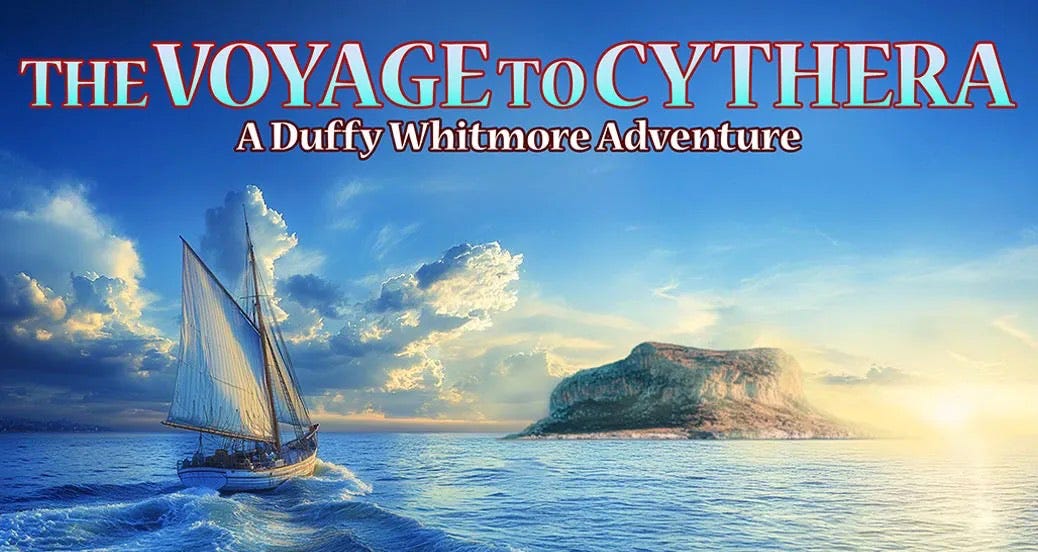
The Voyage to Cythera
• A Duffy Whitmore Adventure •
Prologue (from Duffy’s Travel Compendium)
Avlospilos, Third of June ‘36
Arrived at The Aphrodite to find the hotel disagreeably pleased with itself. The walls are a pale shade of envy, the staff all scented with basil, and the melon arrives with such frequency one suspects they grow them in the lobby. Trevor is with me, naturally. His hair has returned to its Edwardian sweep, and he’s acquired a new Leica, which he insists on speaking to in German.
There are rumours—barely whispers, really—of a ruined temple on Cythera. Not the postcard ruins. Real ones. Preposterous, of course. But Trevor has that look again—the one he wore just before we nearly got detained in Aleppo. I’ve written to Lord Thornton to say we’re merely “exploring the peninsula.” He will not believe me.
Trevor and I were presently luxuriating at The Aphrodite—a rather smug little hotel perched above the boat harbour at Avlospilos, not far from the tip of the Peloponnesian Peninsula. The establishment was tiled in turquoise, scented with thyme, and staffed entirely by young men in linen tunics who refused to make eye contact unless it was to express sorrow that the melon was not quite as chilled as it ought to be.
Chapter I:
Of Melon and Abyssinia
We were being plied that morning with a particularly aromatic pot of Ethiopian roast—Trevor insists on calling it “the real Abyssinian,” as though invoking Haile Selassie’s blessing with every cup. I was paging through a copy of Baedeker’s Southern Europe (1932), while Trevor muttered to himself about lens speeds and focal ranges and fiddled with the dials of his Leica as if preparing for a summit with the dead.
Our purpose—if one must be declared—was to investigate rumours of architectural remnants on Cythera: whispers of Doric columns and sacrificial altars lingering in a grove Baudelaire would have us believe had long since surrendered to scrub. I had recently unearthed an obscure essay suggesting otherwise, and with Trevor’s Leica in hand and the Aegean glinting like a sequined scarf, we’d resolved to see for ourselves.
We hired a sailboat that afternoon from a lithe and sun-browned British expatriate named Olivia Harrison, whose movements were as economical as her vowels. She wore canvas shorts and a sleeveless blouse knotted just above the waist, and carried herself with the air of someone who could reef a mainsail in a crosswind whilst reciting Browning. Trevor, predictably, was smitten by the time she stepped aboard. “Now she’s a bit of the alright,” he whispered, elbowing me with the subtlety of a goat.
The plan was simplicity itself: sail across to Cythera, make landfall near the supposed temple site, lunch among the ruins, photograph whatever had not yet collapsed, and return in time for sundowners. But as any student of Greek mythology or modern travel knows, no plan survives Poseidon.
Chapter II:
Poseidon Intervenes
No sooner had we cleared the headland than the docile tradewinds stiffened into a spiteful gust. Olivia snapped to command with unflustered grace, barking instructions with clipped precision. “All hands on deck!” she cried, and to our horror, the hands in question turned out to be ours.
Trevor, juggling ropes like a flustered magician, managed to lash something important to something else entirely. I was sent forward to assist with the jib, though I spent most of the effort clinging to the rail and quoting Euripides. The boat pitched and yawed like a sulking dolphin, and our elegant outing descended rapidly into nautical farce.
When at last we limped into a calm, sun-warmed cove, Olivia dropped anchor with a sigh of relief and declared the situation stable enough to break out the gin. We had, she said, been blown off course.
Cythera, that storied isle, was now somewhere behind us. Before us stood a smaller island entirely: Anti-Cythera. A speck on the map. Ignored by scholars, dismissed by tourists, and, at that moment, utterly perfect.
The cove was, by any measure, idyllic. The cliffs were low and terraced with scrub olive, the water shone with a turquoise clarity one suspects is added later in the postcards, and the beach—crescent-shaped and utterly deserted—invited poetic foolishness.
Olivia, ever competent, secured the boat for an overnight stay. Lanterns were hung fore and aft, casting a golden spill across the deck. The sea lapped obligingly. Trevor, still pink with embarrassment from his rope-handling, opened the drinks chest and poured three gins with the solemnity of a priest dispensing unction. Olivia accepted hers with a smirk.
Trevor was soon recounting our brush with ruin like a survivor of Salamis, and Olivia listened with one leg propped against the railing, smiling in that maddening, ambivalent way women do when they know full well you’re trying to impress them. I, meanwhile, turned my attention to the shore.
About a hundred yards up from the beach, half-hidden by tamarisk and shadow, stood what looked unmistakably like a small circular colonnade. Derelict, yes. Cracked and leaning, probably. But columns all the same. Five, perhaps six, arranged in a ring. No roof. No signage. No tourists. My heart did a little skip. Everyone, after all, goes to Cythera. No one spares a thought for its tiny, disreputable sister. Perhaps—just perhaps—we had found something undiscovered.
I excused myself on the pretext of needing a stroll and lowered the dinghy into the water. Trevor mumbled something about minding the tide. Olivia waved, then returned her attention to the stars—or to Trevor. It was difficult to say which.
Chapter III:
Anti-Cythera and the Adonis Misunderstanding
The moon lit the beach like theatre footlights, and my little dinghy bumped onto the sand with the sound of a dropped shoe. I stepped ashore, notebook in pocket, binoculars slung round my neck. The air was warm and sweet and still. The sort of night one imagines ends with either poetry or peril.
The columns were older than I had hoped but younger than I’d feared. Marble, or something pretending to be. Overgrown with ivy, certainly. But still noble, still upright. A modest temple, perhaps. Or a folly built by some forgotten Venetian.
As I approached the structure, I noticed something strange. Music. Faint, yes—but real. Not wind or sea or imagination. The high, fluttering sound of a lyre. And beneath it, drums. Steady. Ritualistic. They were coming from the far side of the ruin.
I stepped inside the colonnade, meaning only to peer through—and stopped short.
A group of figures—women, by the look of them—were emerging from the trees. All in white, all barefoot. Their garments diaphanous, their hair unbound, their arms laden with garlands and amphorae. They were speaking—but not in Greek, not in English either. Something ceremonial. Something theatrical.
One of them saw me.
She halted. The others did too. Then, slowly, they smiled.
I turned to leave—cautiously, politely—but two of them had already approached. They took my hands, gently, as if greeting a guest long expected.
“Adonis,” one of them whispered, bowing her head.
I would later swear I tried to explain. But no one seemed especially interested in my passport.
Chapter IV:
The Crinkle and the Compass
Back aboard the boat, Olivia glanced toward the shore and frowned.
“He’s been gone too long,” she said.
Trevor waved a hand. “Duffy’s always wandering off. He once spent three hours inside a disused minaret in Cairo photographing graffiti and stray cats. Said it was a metaphor for colonial decline.”
“This is different,” Olivia said. “He took no torch. And he’s not answering the signal whistle.”
That did it. Trevor, to his credit, retrieved his camera and a waterproof bag he’d recently purchased from a clever little company in York, of all places. “Right,” he said. “Let’s go get him.”
They swam ashore—Olivia cutting through the water like a fish, Trevor splashing valiantly beside her, one arm held aloft to protect the bag. Later, he would insist the scene reminded him of From Here to Eternity—though the film wouldn’t be made for another twenty years.
As they reached the beach, they were greeted not by silence, but by music. Real music. Torchlight flickered from beyond the ruin. The lyre sang. The drums pulsed. The air was thick with thyme and theatre.
They followed the path to a clearing, and there, in the centre of the ruined colonnade, stood Duffy—being worshipped, or restrained, or possibly both. Around him danced a dozen women in diaphanous white, torchlight catching on hair and hem, eyes closed in ecstasy or well-rehearsed imitation.
Trevor and Olivia froze.
“He’s been offered up,” Trevor whispered.
“I don’t see a knife,” said Olivia. “Let’s not panic.”
The leader raised her arms. The dancers paused. All eyes turned to Duffy, who looked profoundly uncertain.
Olivia stepped forward. “Excuse me!”
The high priestess turned with a hiss. Olivia did not flinch.
“Whatever ritual this is,” she said crisply, “he’s not your Adonis. He’s a travel writer with weak ankles and a fondness for fig jam.”
A pause.
Then the priestess dropped her register entirely. “Look, I don’t know who booked the cove for tonight, but we’ve had this full moon scheduled for weeks. We don’t usually get walk-ins.”
Trevor, ever the opportunist, opened the bag, unwrapped the Leica, and began shooting. He whispered something about slow exposures and heavenly blur.
Epilogue:
Cythera in the Mist
The Kodachrome, later developed at a tiny shop near the hotel—newly licensed by Kodak and very proud of it—produced slides that, imperfect as they were, hinted at something unclassifiable: a tangle of light and limbs, timeless and blurred by movement.
Weeks later, when Trevor showed the prints to Lord Thornton—our ever-gracious patron and amateur mystic—the reaction was instantaneous.
“Remarkable,” said Ruffles, leaning back in his wicker chair and blowing cigar smoke toward the ceiling fan. “You’ve captured the very crinkle itself. That fold in time. The moment when Now and Then trade hats and forget who’s who.”
One evening, on the terrace overlooking the Aegean, with Cythera rising out of the mist and looking entirely mythical, we took drinks at sunset. Olivia appeared carrying a mango in one hand and a tall glass of pink lemonade and vodka in the other.
“Ah, Captain Olivia, come join us,” said Trevor, rising and pulling out a chair.
“You’ll join us in Kenya, of course,” he said.
She looked up, surprised. “Will I?”
“There’s a safari,” Trevor said. “Lord Thornton’s organizing it. He’s bringing half of Sussex and a large gramophone. It’s entirely absurd. You’ll love it.”
Olivia smiled. “Only if I can bring my own compass.”
I, seated nearby with a restorative brandy and a sprig of parsley I’d mistaken for mint, raised my glass faintly.
“To Anti-Cythera,” I said.
“To getting blown off course,” Trevor added.
“To very nearly being sacrificed,” Olivia said, clinking glasses.
And with that, another chapter was sealed—its meaning, like most good travel, entirely debatable.
–– Duffy Whitmore


