

Wish you were here.
xo, Margot and Duffy

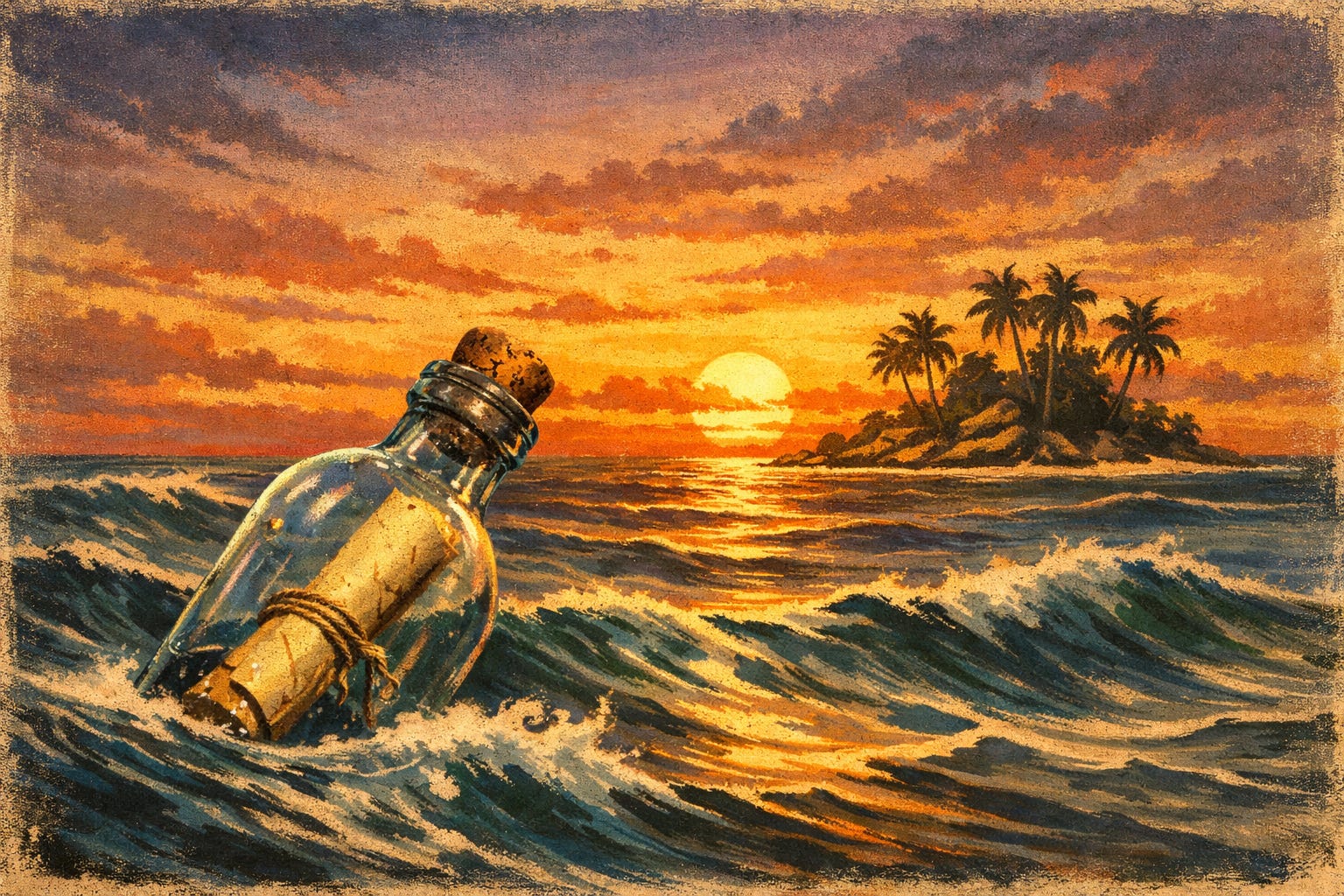
I had always suspected that if I were ever shipwrecked, it would occur during a period of moral decline — mine, not civilisation’s. A mega-yacht, champagne climate control, people congratulating each other for surviving success — precisely the sort of floating society nature occasionally audits.
The audit arrived shortly after midnight.
By dawn I was swimming beside Margot Robbie through a warm, indifferent sea toward a strip of sand that appeared to have been designed by a travel brochure and then abandoned by God.
“Good morning,” I said, treading water. “I was hoping to meet you under better circumstances. Cannes, perhaps. A charity auction.”
She squinted at me. “You’re flirting while drowning?”
“Drowning is temporary,” I said. “First impressions are permanent.”
We crawled ashore together — two survivors of modern luxury now reduced to prehistoric negotiation with gravity. The yacht had disappeared with impressive finality, taking with it everything useful except, mercifully, embarrassment.
For several minutes we lay on the sand, breathing like bellows.
“Well,” she said, “we’ve finally escaped scheduling.”
“I’ve been trying for years.”
“Took a shipwreck. That feels inefficient.”
The First Day — Civility
Survival begins, I discovered, not with fire but with manners.
We inventoried ourselves.
Two people
No shoes
No phone signal
One watch (mine, decorative)
One hair tie (hers, critical infrastructure)
The island rose behind us in green tiers — coconut palms, dense brush, volcanic stone. A small stream glittered inland. We looked at it the way medieval pilgrims must have looked at relics.
Fresh water.
She stood, brushing sand from her arms. “We should boil it.”
I looked around. “We should invent boiling first.”
She laughed — not movie laughter, not promotional laughter — the laugh of a person acknowledging absurdity while choosing competence.
That was the moment I stopped seeing a celebrity and began seeing a partner.
The Shelter
We agreed immediately: no beach sleeping. The ocean giveth and occasionally reclaims.
A little above the tide line we found fallen timber and, more importantly, a tangle of nautical rope washed ashore — a generous, miraculous knot of civilisation.
I have always believed a man’s character is revealed by how he handles rope.
Within an hour we had erected a slanted roof between two palms. By evening it had walls. By sunset, a respectable fortress.
Margot proved unexpectedly gifted at structural decisions.
“No, that angle will trap rain,” she said, moving a beam I had proudly placed. “You want runoff away from the sleeping area.”
“You’ve done this before?”
“I grew up outdoors more than people think.”
I nodded solemnly. “I grew up indoors more than anyone hoped.”
We improved rapidly.
By dusk we possessed a shelter that would not embarrass a competent beaver.
Water and Food
We braided coconut husks into catch basins, rigged leaves into gutters, and suspended them with rope. I carved a spear from a straight branch. My first throw struck only philosophy.
Her second throw struck a fish.
She tried to look apologetic.
“I’m beginning to suspect you weren’t brought up exclusively in Chelsea.”
She smiled. “I didn’t say I couldn’t feed us.”
From then on we ate — modestly, triumphantly. Raw survival tastes better than catered elegance.
We built a rack from driftwood and hoisted our food high using block-and-line improvisations. The rope — our inheritance from the yacht — became architecture, furniture, and engineering degree.
Hammocks followed.
Civilisation, I realised, is merely tension properly distributed.
Evenings
Fire changed everything.
We sat before it that first night like refugees from abstraction. Without screens, roles, or audience, conversation settled into honesty.
We spoke about childhood first — the universal language of displaced people. Then work, then fear, then silence.
The fire produced a curious phenomenon: neither of us was impressive anymore. Only present.
She studied me once and said, “You’re different now.”
“Sunburn improves character.”
“No,” she said softly. “You’re not performing.”
I considered that.
On land, everyone performs — the successful, the cynical, the beautiful, the aging. On an island, performance wastes calories.
I nodded. “I appear to be running on sincerity. It’s new fuel.”
The Crisis
The metal hook was my fault.
A large piece of polished fishing gear had washed ashore. I leaned it against a coconut tree to examine later. It caught the afternoon sun and flashed brilliantly out to sea — a small, stupid lighthouse.
At dusk we saw the canoe.
Long, narrow, purposeful. Several figures.
We did not speak. Civilization returned instantly in the form of strategy.
We extinguished the fire and retreated to our tree-line shelter.
They came ashore quietly. Not savages — never that simple — but organised hunters following a signal that should not exist.
My signal.
We waited, breathing together in darkness. Her hand found mine without ceremony. Not romance — alignment.
I whispered, “We stay still. They’ll search the beach.”
She nodded once.
The rope saved us again. Our food hoist and hammock lines were invisible among branches. We climbed above eye level and became part of the forest.
They searched briefly, then departed with our metal prize.
The canoe vanished into twilight.
We remained suspended for several minutes afterward, listening to the return of insects — nature’s declaration that danger had concluded.
When we climbed down, she laughed weakly.
“Well,” she said, “that escalated.”
I looked at her, hair tangled, eyes alive.
“We trusted each other immediately,” I said.
“That’s the real rescue.”
The Firelit Evenings
After that, something softened permanently.
We stopped talking about rescue dates.
We still expected rescue — civilised optimism — but we no longer depended on it for meaning.
One evening she watched me repair a spear tip.
“You’ve become very competent,” she said.
“You’ve become very real,” I replied.
We sat beside the fire, the island breathing around us. No costumes, no interviews, no expectations — just two primates cooperating successfully.
Anthropology’s simplest miracle.
She leaned her head against my shoulder, not as a gesture but as a resting place discovered by experiment.
The sea sounded less like isolation and more like privacy.
We did not discuss tomorrow.
The fire required tending, and so did we.
—Duffy Whitmore